Things it could be…

MS, Lupus, Parkinsons, Motor Neurone disease.

6 years ago today a Neurologist came into my room to tell me the head MRI that had been ordered by an Endocrinologist who had noticed I had Nystagmas was abnormal. She gave me a list of conditions it could be but said she didn’t really know and that they’d send me for a second MRI with contrast to check all the vessels etc and that she’d be back the following day to discuss it with me.

I never saw her again and it was my Immunologist who finally diagnosed my ataxia and the genetic abnormality causing it.

Growing up I could never hop on one leg, ride a bike or catch a ball. My ex pointed out when walking up curbs I always lifted my foot double the height of the curb to make sure I didn’t trip up it. When I was 21 I could feel my balance worsening and joked with my flatmate at the time that it was because I was going out clubbing and dancing less than I use to.

As I got older I attempted dance classes with ballroom, latin american and specifically Salsa and found them to be more and more difficult so the ataxia does make sense looking back.

I refused to see Basingstoke neurology again and instead saw a wonderful Neurologist in Oxford who eventually referred me to my current Professor after my amazing Immunologist read a paper on Ataxia-Pancytopaenia and thought it fitted me completely.

So after exome sequencing, the mutation SAM9D-L was found. Unfortunately it’s so rare it can’t be predicted how I will progress but losing my balance sideways is totally boring and irritating.

I see my professor once a year although I can get in touch with him as needed. I’ve joined a load of Ataxia groups on facebook and groups regarding wheelchair holidays and accessibility.

So six years ago my ataxia journey started properly and having a name for the stumbling, losing balance, choking, speech slurring and inability to walk makes it easier to handle but walking normally would be even better as my body had made too good a friends with the floor and walls.


Steps….

So everyone is talking bout the death of the high street and as much as I try to shop in my local stores I am a big user of Amazon for several reasons.

Yes it’s quick and easy and with Amazon Prime I can get most items delivered the next day, however the main reason I use it is the inaccessibility of so many shops. Steps everywhere is the first and biggest prevention and is a prohibitor not just for those using a wheelchair or mobility scooter but those who still walk with sticks and crutches but find steps a big problem.

So many high street shops (mainly independants) have at least one step at the entrance which immediately means I can’t even consider going in to them. This inaccesibility leads to me ordering online instead or going to a shop which I can get into.

At least these shops identify to me quickly they are not suitable for me to go into even if they are missing out on my business.

Worse than this though is the shops that make you think they are accessible but once you enter then you realise they aren’t and even trying to get out you know it’s going to be difficult often resulting in knocking into items etc.

For me the worst experience of this was in an H&M where there was so little gap between the rails that I couldn’t look at any of the clothes and on trying to leave, my wheelchair sent many items of clothing to the floor.

Shops nowadays also try and fill every bit of floor space with stock so it may look accessible until you are in there and the end of a shelf which you’ve identified as a perfect turning spot has a load of extra stock making it completely impossible to get out.

Payment tills are also a problem as this is when shops try to upsell things you don’t really need. This is fine but means there is limited room for wheelchairs and scooters to get past and if there is a customer between the til I need to get to and me then all hope is lost as there is rarely enough room.

This post if by no means meant to be a moan but an explanation as to why so many of us with mobility issues do so much of our shopping online, it stops immense worry and inability to access shops.

The Need to Rest

The other night a friend asked me how many of the 24 hours in a day I rest to which I replied ’20’. Thinking more about it I think recently that was an understatement and it’s currently more like 23 with the final hour made up of cooking, going to the loo, getting ready for bed etc.

I may have the odd day where i sort and hang out the washing, go shopping, walk the dog etc but these are only on days i feel up to it.

I’m currently dealing with an arthritis flare up affecting my ankles, knees and wrists so resting is high on my to do list.

Today I woke at 9am and by 11am had fallen back to sleep on the sofa and slept for 3 hours.

Chronic illness means you need rest and pain makes it even more necessary, so that’s what I’m doing and what so many others have to do.

We would love to work but can’t, we would love to socialise more but can’t, we would love to do more in life but can’t.

So don’t feel sorry for us but also don’t judge us.

It’s been a month

A month ago today was my last day employed. The fatigue got to much for me to manage to work even a little bit so I had to stop.

Those closest to me have been so supportive of my decision knowing how much I have struggled the last few months and how stopping work goes against all my beliefs and independence issues.

Others have tried to be supportive but missed the mark a bit with their comments.

So here’s something to remember. If those of us with chronic illness have to give up work it is not something we are choosing but is something we have to do to look after ourselves. We do not enjoy not having something to occupy our brains or distract us from how we are feeling.

IT IS A NECESSITY NOT A CHOICE

I was lucky to work for an organisation that let me work the hours I did but many part time jobs still require 20 or so hours a week which for a lot of people with chronic illness is too many. So before you judge us for not working or say how lucky we are, think about our entire situation.

Last day

Today marks the last day of world primary immunodeficiency week an official week to raise awareness of primary immunodeficiency but in reality those of us affected should never stop raising awareness amongst family, friends, healthcare workers and the public.

I have learnt quite a lot this week in that the anger some patients feel at having this condition outweighs the fact that we can receive treatments for many of the conditions and the benefits this treatment gives us.

I will always be thankful because i know without this treatment and the NHS I would probably not be here today.

Yes to be diagnosed with a rare condition (or 3) sucks but we are so lucky to live in the UK where we receive treatment for it and have access to specialists in the condition we have. Many countries have limited if any access to treatment and do not have Immunologists patients can see and therefore have to travel abroad just for an appointment.

When it comes to treatment and receiving infusions we are lucky to have the option to infuse at home. Until I was 7 or 8 my mum and I had to travel to Oxford every 3 weeks for my infusion meaning i had to take time out of school and mum work. Now I infuse at home once a week when suits me in a time window.

So what I’m trying to say is that yes it can be s**t but we are lucky to live where we live in the time we live.

Day 4

Today is the 4th day of World PI Week and it has been a little stressful.

Although I gave up work at the end of March I always said I would do the facebook for PID UK and unfortunately some patients took against one of the pictures provided by World PI Week.

The picture was of a patients personal quote about how much their life had improved on Immunoglobulin Therapy. Whilst I do not refute that many patients lives are not perfect health wise once they have started treatment I do not accept that no ones life is even slightly better on Ig replacement therapy once they have been diagnosed.

For a recap I have

Primary Immunodeficiency
Crohns Disease
Psoriasis
Arthritis
An exceedingly rare form of ataxia
Myelodysplasia Syndrome

and yet even with these conditions I feel lucky 90% of the time.

If I had been diagnosed with several of these disorders even 80 years ago I would probably be dead.

I could of caught several severe infections that could of killed me or bled to death from my Crohns.

Luckily I have an incredible team of doctors around me wonderful family headed up by my mum, dad and sister and amazing friends.

In my 31 years I have been taken off my infusions several times to see if my immunedeficiency had sorted itself out. Each of those times I was so ill and ended up in hospital and would have died had I not restarted treatment.

So no Ig treatment may not turn your life around if you are a PID patient but it definitely makes it better than if you weren’t to have it.

Day Two

Today marks the end of day two of world pi week so I thought I’d give you some facts and answer some questions.

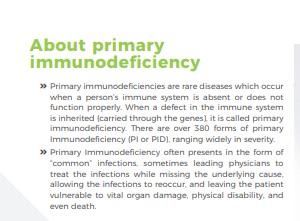
There are nearly 400 primary immundeficiencies (PIDs).

They are genetic disorders and are NOT contagious (you cannot catch a PID from a patient whether you hug, kiss or sleep with them)

My particular PID has changed names over the years as science and medicine has evolved, when I was young it was just Hypogammaglobulanaemia, then it was Common Variable Immunodeficiency and then Primary Immune Dysregulatory Disorder and now since my Ataxia Pancytopaenia gene mutation was discovered the doctors don’t seem to know exactly what to call it.

I was lucky to be diagnosed as a baby to avoid some of the non diagnosed illnesses that late-diagnosed patients are affected by.

WPIW 2

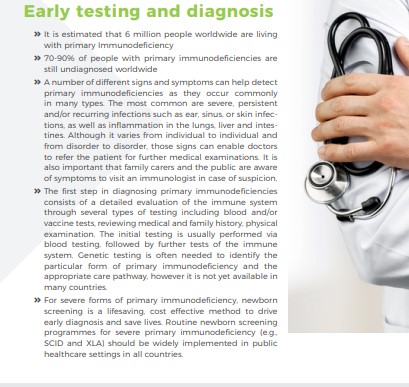
As the image above shows misdiagnosis and un-diagnosis are still massive issues and un-diagnosis can lead to serious health problems affecting a patients entire life.

PID patients are not currently covered by Medical Exemption so we pay for each of our prescriptions, although most PID patients have a pre-payment card to stop our prescription costs spiralling.

I do my infusions into my stomach (subcutaneously) whilst others do theirs into a vein (intravenously). I did infuse into a vein until I went to University and wanted the freedom to infuse at a time suited to me. During 13 years of infusing subcutaneously I have only had one reaction that caused concern and although it means if I go on a holiday for more than 13 days I have to take my infusion gear with me I do find it a lot easier.

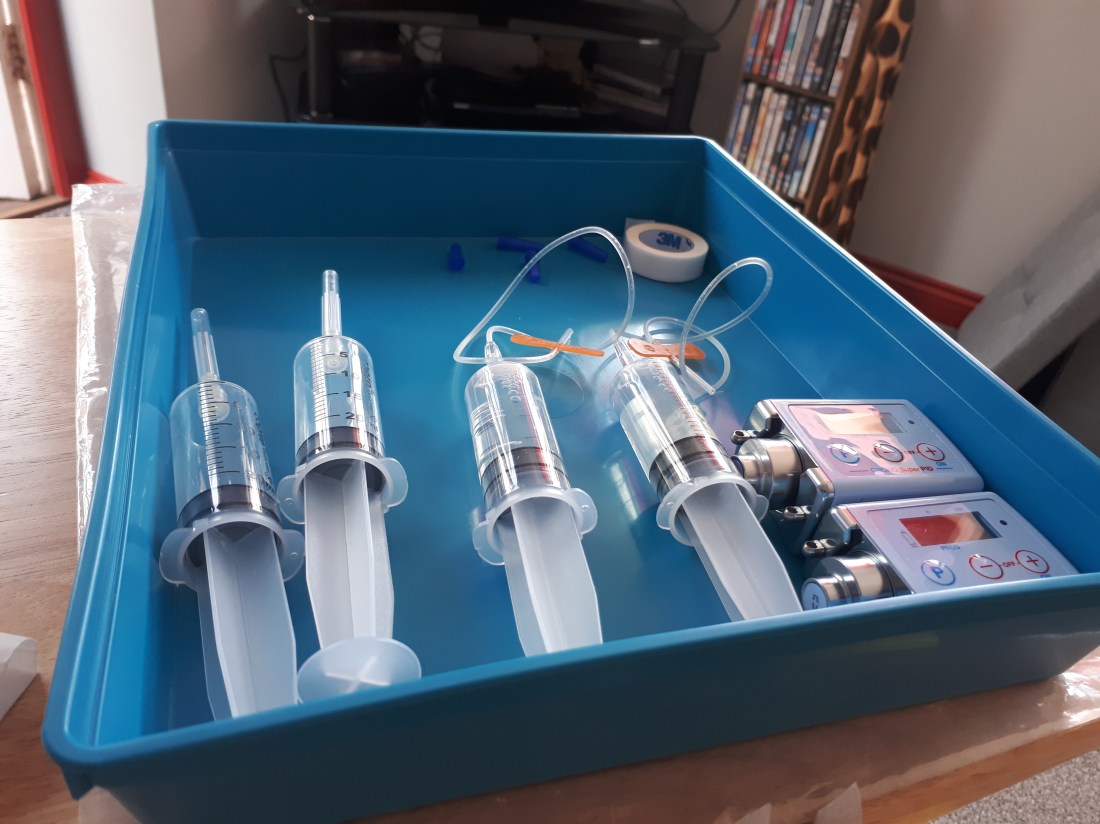
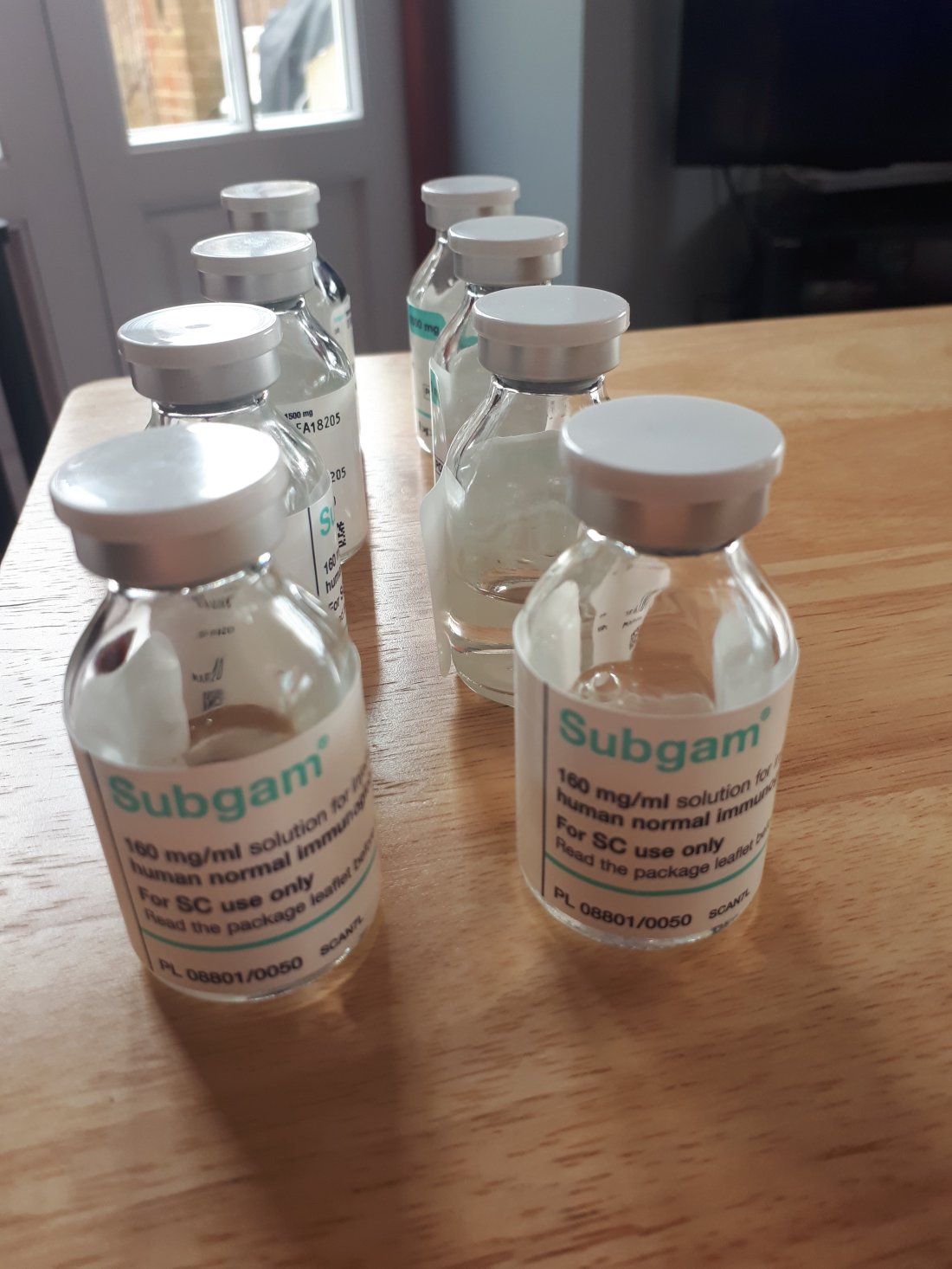
So 8 bottles, 4 syringes, 2 needles keep me healthy(ish) each week and long may it continue!!

Today it Begins

World PI Week 2019 began today. This awareness week may not mean much to so many of you but to those of us with primary immunodeficiencies it is an important week of the year; a chance to raise awareness of a condition we live with everyday.

As it happens today was the day I had to do my infusion. This occurs once a week and is an infusion of other people’s antibodies to keep me healthy. For me and so many others this product is our “liquid gold” keeping us well and healthy.

Each week I infuse 80ml/12grams via two needles over 1 hour.

My product is Subgam and I infuse subcutaneously into my stomach

Some patients choose to infuse every few weeks into a vein more often in a hospital.

I hope that explains my weekly treatment and please do spread the word about primary immunodefiencies both this important week and the rest of time.

Happy Easter

I hope you’re all having a lovely relaxing time.

Having had my niece and nephew for an egg hunt yesterday today I am relaxing.

Everyone expects Easter weekend to be fully packed but those of us with chronic diseases need to prioritise self care and resting so taking it easy is the main thing.

Having given up work at the end of March I sleep most days so a four day weekend isn’t really any different but the temptation to overdo it is present and something I have to resist. If I had a busy weekend I know I would suffer for it.

I’m celebrating today in my own relaxed way with my dog who is running in and out from living room to garden and back again.

So my main message today is to let people celebrate in their own way.

Tomorrow marks the 1st day of world primary immunodeficiency week 2019!!

People can be exhausting

So this is something “healthy” people don’t always understand. Being sociable and surrounded by people can be exhausting.

I live on my own with my dog. I spend 75% of my time sleeping and resting. More than  handful of people currently tires me out so I’ve had to start saying no to things.

For me it’s not just a matter of being tired but that when I’m tired my ataxia gets a lot worse to the point I can barely walk or talk, eat or drink without choking.

This will resound for many people with rare and chronic illness, generally we are not good with crowds, we get tired easily and cannot be as outgoing as we would like. We are not being antisocial, we would love to join in lots of activities but can’t.

I know each weekend I can only do one thing and if it’s an evening event I need to nap before it to get through it. It sucks but I’ve learnt pushing myself through several things is not worth it.

If several things are happening over several days that I really don’t want to miss I’ll make sure that the following few days are empty so my body can recover as I sleep.

I guess this comes back to the “spoon theory”  and not having enough energy for everything. Personally I don’t like the spoon theory as I find it too simplistic as you never know how much energy you are going to have to begin with or how much energy an activity will use up but in getting people to realise that you don’t have limitless energy it’s a good idea.

So if we pass up on a fun day out, or any chance to be social don’t take it personally we’re just saving ourselves.