Featured

Fatigue again

I know I’ve blogged about fatigue before but it’s apparent there is still misunderstanding about it

There’s a scale: regular people tiredness, fatigue, chronic illness fatigue, chronic illness exhaustion.

So when I say “I’m tired” it generally means I have chronic illness fatigue.

The problem is fatigue affects my balance, coordination and gives me night sweats which mean I don’t sleep as well and walking about becomes harder taking more effort to do things.

I generally only can manage to do one thing a day due to lack of energy and if something big is coming up I’ll have a “do nothing day” before it.

It has become apparent over the last 5 months that some people don’t understand this with the response on a “do nothing” day of saying several times “so you really don’t want to do anything today?” Along with not believing or accepting I can only do one thing a day and pressuring me to do more.

This week my parents moved house so I had their dogs for three nights and four days. It has utterly exhausted me even if I did love having them. I can’t risk walking about because I’m so tired my balance has gone and my physio had the joy of seeing the effect on me from Wednesday to Friday.

Today she kept telling me to lower my shoulders but understood they were high from being tense and tired so I may not have been able to lower them.

When the dogs were collected I admitted how exhausted I was by them and the response “were tired too”.

There’s a difference between your tired and my exhaustion. Mine leaves me emotionally drained and ready to cry at anything

Infliximab Time

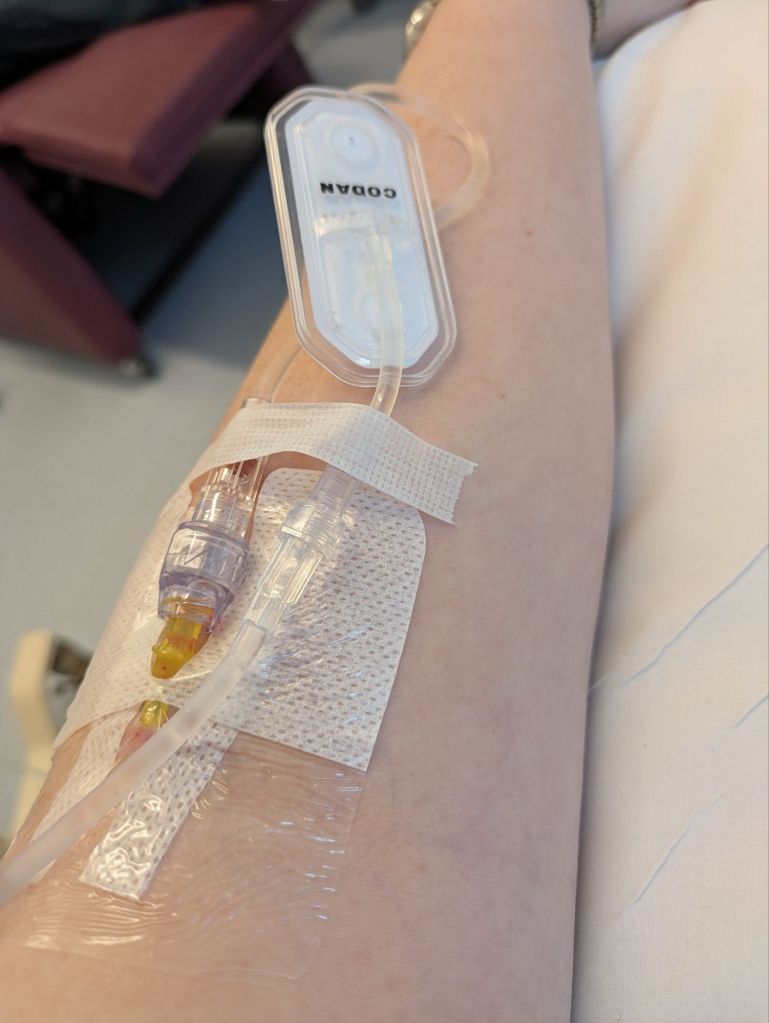
For my Crohn’s Disease and Arthritis I have Infliximab every six weeks. Most people are on it 18 months, I’ve been on it over ten years.

It’s desired effect has reduced so in the last few years so the amount has been doubled and the time between infusions shortened.

Clinical guidelines say a level of 8 is okay but above 12 has shown to have the best results and unfortunately as expected my levels have dropped from 13 over time so we’ve put a plan in place for when Infliximab stops working.

I have previously tried a drug called Ustekinemab but unfortunately it didn’t help my arthritis pain so that’s a no go so we have a plan in place for a different drug (can never remember it’s name) for when Infliximab stops working and I see my consultant in 6 weeks so we’ll discuss it further.

Featured

Immunology January 2026

Today I had a three month medicine delivery; 36 bottles of immunoglobulin, 36 syringes, 24 butterfly needles plus a sharpsbin. The immunoglobulin goes in my fridge and the rest into a neat chest in my living room. Weekends are generally infusion time, setting up the tray downstairs but infusing upstairs in bed.

Last week I saw my Immunology consultant and despite them running late and three attempts to get blood from me it was a pretty good run of the mill appointment.

If you’ve ever tried to park in a hospital car park you’ll know it’s not easy so we leave an hour just to park. If we’re lucky and get a spot quickly we go to the M&S cafe and last week I had a hot chocolate and pain au chocolat before heading to the clinic which was really good because of the whole running late issue.

My consultant likes me to meet her registrars as a test for them because I’m so complicated. The one I saw last week I had spoken to a lot in the summer when a bad leg infection hospitalised me for two weeks. She was brilliant and my tricky question this year was

“if tests showed i made no antibodies or t cells to the Covid jab will I be to the flu jab”

Unfortunately the answer was “we don’t know” but as I’ve not had flu that i’ve known about for years it’s worth me continuing the flu jab.

This however does lead back to my issues with anti-vaxxers. Despite having many Covid jabs at the beginning I responded to none of them so relied on others having the jab to keep me protected.

Other than my flu question it was a run of the mill appointment with no issues other then my ataxia progressing but the taking of blood was another matter to be discussed another time!!

Featured

New Year 2026

Happy New Year everyone!! My new years resolution is to go to theatre and shows more. So far I have the Blue 25th anniversary tour in Bournemouth and Beyond the Barricade in Basingstoke. I’m hoping to also book Tease in Basingstoke as well.

The biggest problem is that venues have a very limited number of wheelchair spaces (I couldn’t get tickets to Westlife 25th anniversary tour because of this) and some have even less cheap companion seats available leading me to have to pay for a wheelchair space and a companion/carer seat as most places won’t let a wheelchair attendee be on their own (my legs don’t work properly but that doesn’t mean I cant get out of a building in an emergency).

The other issue is that the limited number of wheelchair seats are often at the back of the theatre which I understand as a lot of them are older buildings but it means a worse view feeling less involved.

The third issue is that most wheelchair spaces only allow one companion/carer space so if you want to go as part of a big group chances are you’ll be sitting separately. This is especially true if you want them to be sitting in good seats. (I once attended a touring production of The Lion King and I sat in my wheelchair at the back whilst my family sat near the front with their kids because I didn’t want them to be stuck at the back).

It’s for these reasons I love The Anvil in Basingstoke; the wheelchair seats are near the front, you get a cheaper companion/carer ticket and you’re in the stalls so if you have a big party they can be near you. They do still have a limited number of wheelchair seats but a call early in ticket release generally secures them.

Which leads me to my final question; why do so many venues require you to phone for accessible tickets whilst non disabled can book theirs online?

Featured

Over 25 years ago

25 years ago I had a stoma after a subtotal colectomy. I had a stoma 18 months or so before insisting on an ileo rectal anastomosis because pooing into a bag age 12/13 whilst at boarding school with bitchy girls was horrendous.

My journey to my first big op was interesting. Symptoms of diarrhea and weight loss started age 7. I distinctly remember going for a colonoscopy and the nurse telling me “you’re very young to be here”.

And so began 5/6 years of medication, hospital appointments with a Gastroenterologist, phone calls with the gastro nurse and several blood transfusions to replace the blood I lost through diarrhea.

None of it worked and in the summer of 2000 the consultant recommended that the best next step was a colectomy which after years of feeling like crap I was vaguely all for but adamant the stoma would be temporary.

I was sent for a second opinion at GOSH and I have to say my experience and memories are not great.

They placed a nasal gastric tube for several days and no one believed when I said I felt sick. I wretched and the tube that started down my nose looped out of my mouth before continuing down my gullet. They just fed it back down and didn’t even give me anti nausea meds.

They did a colonoscopy and took biopsies which then made me bleed non stop and didn’t heal.

I was too tall for the bed they gave me.

I was desperate to be out of there so lied to them that I was fine so I could go home (that was not a fun journey).

A short while later I was admitted to Oxford John Radcliffe hospital and had an emergency collectomy.

Due to being so ill when I was admitted it took 3 weeks to be well enough for discharge with my new stoma bag and head home.

18 months later I headed back to hospital for an ileorectal anastomosis. Due to being well when I went in for surgery I was sitting up in a chair 24 hours after surgery.

Subtotal Colectomy

A subtotal colectomy is surgery to remove most of the large bowel (colon) while leaving the rectum intact, typically for inflammatory bowel diseases (Crohn’s, ulcerative colitis).

Ileorectal anastomosis

Ileorectal anastomosis (IRA) is a major surgery where surgeons remove the colon (colectomy) and then connect the end of the small intestine (ileum) directly to the rectum

Scrapping self isolation

Today Boris announced the scrapping of the self isolation law leading to me sending an email to No10 for the first time ever

“Following on from the prime minister announcing today the scrapping of self isolation rules for those who test positive to Covid-19, do I assume correctly that all those of us who have made no antibody response at all like myself and others with primary immunodeficiencies and other conditions will be able to receive the antibody therapies prophylactically to prevent serious illness when those testing positive are allowed to walk around shops with no mask infecting anyone they come into contact with.

If not then the feeling amongst antibody deficiency patients that we are seen as second rate citizens and an inconvenience during this pandemic is true and highly disappointing.”

I have 3 covid vaccines and made no antibody or T-cell response to any of them. I have not sacrificed two years of my life staying inside for the government to decide I really do not matter. The scrapping of self isolation rules without giving those of us who are immune deficient the antibody therapy needed to keep us safe is an appalling thought.

Even those who have responded to the vaccine do not want those testing positive wandering about being able to infect anyone and everyone and I really do not want the risk of hospitalization or death from being infected myself.

So I would urge everyone to contact the cabinet office about this decision and what it means for the most vulnerable in society.

Mental Health Awareness Week

This week is mental health awareness week and after the last year and a bit of the pandemic mental health is more at the forefront of peoples thoughts than before.

Much has been spoken about the mental health issues arising from lockdowns, being inside and restrictions on day to day activities but the mental health impact of lockdown lifting and people being expected to resume day to day activities cannot be ignored.

For so many people who have been shielding due to health or age for a year, jumping straight back into being sociable, sitting in pub gardens, going shopping etc is a huge and often scary step. I personally have not been into a shop for a long time, have no desire to go into a supermarket for several months still and as for sitting inside a pub the thought horrifies me.

Mentally not everyone can jump straight back into the “norm” and to expect them to will impact their mental wellbeing.

Let everyone move at their own pace!

There are some brilliant resources online to help with mental health

Mental Health Foundation http://www.mentalhealth.org.uk

Rethink Mental Illness http://www.rethink.org

mind http://www.mind.org.uk

Mental Health UK http://www.mentalhealth-uk.org

Rare Disease Day 2021

So it’s been an odd year but I can’t let rare disease day go by without a post.

There are over 300 million people living with one or more of over 6,000 identified rare diseases around the world, each supported by family, friends and a team of carers that make up the rare disease community.

Rare diseases currently affect 3.5% – 5.9% of the worldwide population.

72% of rare diseases are genetic whilst others are the result of infections (bacterial or viral), allergies and environmental causes, or are degenerative and proliferative.

70% of those genetic rare diseases start in childhood.

The lack of scientific knowledge and quality information on the disease often results in a delay in diagnosis. Also the need for appropriate quality health care engenders inequalities and difficulties in access to treatment and care. This often results in heavy social and financial burdens on patients.

As mentioned, due to the broad diversity of disorders and relatively common symptoms which can hide underlying rare diseases, initial misdiagnosis is common. In addition, symptoms differ not only from disease to disease, but also from patient to patient suffering from the same disease.

A disease defined as rare in Europe when it affects fewer than 1 in 2,000 people.

So not all my conditions are rare:
Crohns – affects 1 in 650
Arthritis – so it’s never been fully decided which type I have but it is suspected it’s Psoriatic Arthritis – 0.6% of the UK population.

The “HowRare” Ones:
Primary Immune Dysregulation Disorder – unknown/
Ataxia Pancytopaenia – about 25 people worldwide reported in literature but incidence is increasing very slightly.
Myeloid Dysplasia Syndrome – About 4 per 100,000

All these conditions combined together result in an incidence that is non existent. So as far as we know I am the ONLY one in the entire world with this combination of conditions.

So for myself and others I support RDD

48 hours on from Pfizer jab

So on Monday I had my first Covid-19 jab, it was Pfizer and I have NOT had any issues from it. My arm was sore where the jab happened but other then that I’m fine.

The reason I wanted to blog about this was all the misinformation flying about mainly from anti-vaxxers.

The only side effects I have ever heard about is a temperature and a day or two feeling fluey which I feel is a fair effect from a potentially life saving injection.

People like me who are antibody deficient may very well not respond to the vaccine as wanted, hopefully our T-cells will produce some response but as we do not make our own antibodies we will not get the full protection others may so it is important that everyone offered the vaccine has it to increase herd immunity and help protect those who can’t have it or won’t respond to it as well.

I’ve had to reassure many people that the jab is fine and feels just like a flu jab. I was in and out of the centre in 25 minutes.

So if your offered it PLEASE PLEASE PLEASE have it.